A colourful double star system, with a
separation of 10 arc seconds in P.A. 63°. The primary star is mag. 2.2, golden yellow in
colour. The secondary is mag. 5.1, a very contrasty greenish-blue.
R And
00hr 24m
+38° 34'
A long period variable star, located a few
degrees SW of M31. Varies from mag. 5.3 to 15.1 over a period of 409 days.
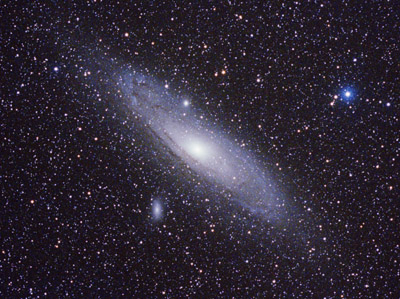
M31! (NGC 224)
00hr 42.7m
+41° 16'
The "Andromeda Galaxy" - the brightest galaxy in the
sky, at mag. 3.5. Located about 2.2 MLy away, covering 192 x 62 arcminutes of sky. The
bright inner core is easily picked up naked eye from a dark site. Much of the galaxy is much
fainter, requiring binoculars or a 'scope to see. Two dust lanes are easily visible in
small scopes with good skies.
M32 (NGC 221)
00hr 42.7m
+40° 52'
Located slightly south of M31, this E2 galaxy
glows brightly at mag. 8.2. Much smaller than M31 at 8.7 x 6 arc minutes, visible in the same
low power field.
M110 (NGC 205)
00hr 40.4m
+41° 41'
Another bright mag 8 galaxy, located
NNE of M31. An E5 peculiar, 22 x 11 arc minutes in size with lower surface
brightness than M32.
NGC 752
01hr 58m
+37° 51'
One of the finest open clusters, visible to
the naked eye from a dark site. 49 arc minutes in diameter, or 1.5 moon diameters. A loose
grouping of 60 stars, 8th magnitude and fainter. Total magnitude is 5.7.
A huge star cloud near the SW tip of M31,
about 2.5 x 4 arc min.
NGC 404
01hr 09m
+35° 43'
An S03 galaxy, located almost on top of b And,
which can make observing difficult. Use medium to high power to get b out of the
field. Mag. 11.2, 3.4 arc minutes in diameter.
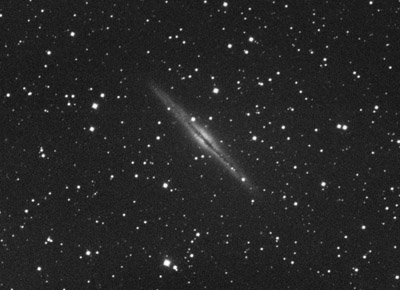
NGC 891!!
02hr 22.6m
+42° 21'
A wonderful edge-on Sb spiral galaxy.
Magnitude 12.2, 14 x 2.4 arc minutes in size. Larger 'scopes will show a bright central bulge,
and a thin dust lane. (110NGC)
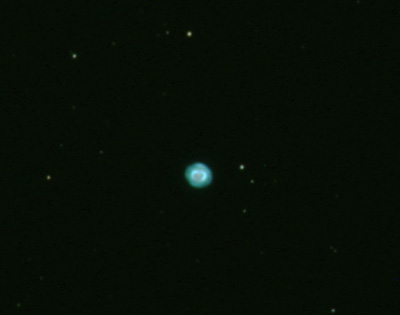
NGC 7662!!
23hr 25.9m
+42° 33'
The "Blue Snowball" - a bright but small planetary nebula. About 17
arc seconds in diameter, mag 8.5. Look for a small bluish-green disk at high power with
a 13.2 mag central star.(110NGC)
NGC 7640
23hr 22m
+40° 51'
Another edge-on spiral galaxy, type SBc(s).
Mag 12.5, 11 x 1.9 arc minutes in size.
NGC 996 Group
02hr 39m
+41° 39'
A group of small 14-15th mag galaxies,
arranged in a circle, about ¼° in diameter.
Photo 1 - The Andromeda Galaxy (M31) with M32 'above' the nucleus
and NGC 205 (M110) 'below'. The bright star is n Andromeda.
South is at top to match the view in an inverting telescope.
Photo credit: John Mirtle.
Photo 2 - The edge-on spiral galaxy NGC 891.
South is at top to match the view in an inverting telescope.
Photo credit: John Mirtle.
Photo 3 - The planetary nebula NGC 7662.
South is at top to match the view in an inverting telescope.
Photo credit: John Mirtle. ^ top