A long period variable star, swinging from mag 5.8 to mag 12.4 over
a period of 387 days.
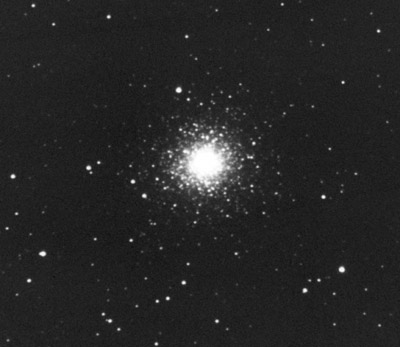
M2 (NGC 7089)
21hr 33.5m
-00° 49'
A bright (mag. 6.5) globular cluster, located 5° north of b Aqr. Only a few
arc minutes in size smaller than M13, measuring 12.9 arc minutes in diameter. Use high power with
medium sized scopes to resolve into stars.
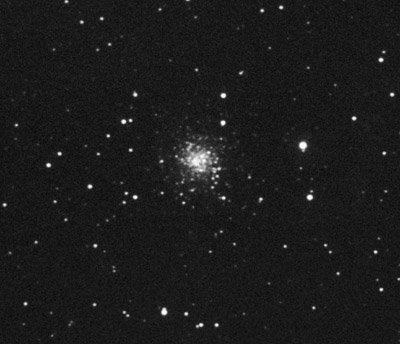
M72 (NGC 6981)
20hr 53.5m
-12° 32'
Another Messier globular cluster, smaller and fainter than M2. Mag 9.2,
only 5.9 arc minutes in size. A 6 to 8" scope will give partial resolution at high power.
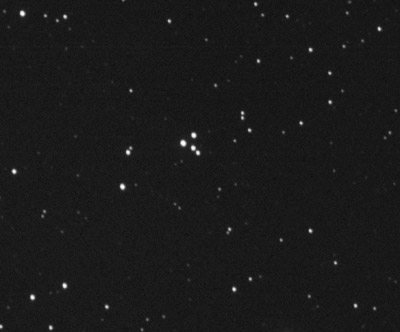
M73 (NGC 6994)
20hr 59.0m
-12° 38'
Located about 1.5° SE of M72, this is one of the most disappointing of the
Messier objects. An asterism of 4 stars, 2.8 arc min. across, mag 8.9. Worth looking at once.
The "Saturn Nebula" - an easy planetary nebula. Magnitude 8.3,
28 arc seconds in size. Look for 2 protruding ansae or "ears" and a 12th mag. central star. (110NGC)
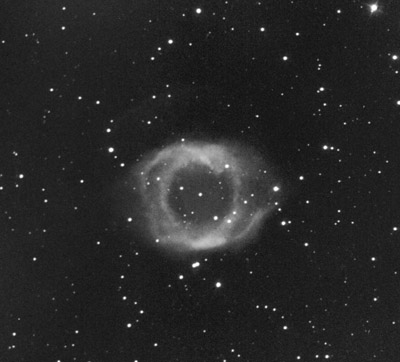
NGC 7293!!
22hr 29.6m
-20° 48'
The "Helix Nebula" - a huge planetary nebula. Mag 6.5, spread over an
area 769 arc seconds in diameter. Can be difficult to observe due to it's low declination, but responds
well to almost any LP filter. Look for the 13th mag bluish central star. (110NGC)
NGC 7492
23hr 08m
-15° 37'
A third globular cluster, much fainter at mag 11.5, 4.2 arc minutes
in diameter. Large aperture scopes required for any resolution.
NGC 7606
23hr 19m
-08° 29'
An 10.8 mag spiral galaxy, 5.8 x 2.6 arc min in size with a bright core.
NGC 7727
23hr 40m
-12° 18'
A nice mag 10.7 S(B)a pec galaxy. 4.2 x 3.4 arc minutes.
NGC 7184
22hr 03m
-20° 49'
A nice Sb spiral galaxy, a few degrees east of the Helix. Mag 11.7, 5.8 x
1.8 arc minutes in size.
A pair of challenging galaxies, small
and faint. 7181 is the brighter one - 0.9 x 0.7 arc minutes, mag 15.0. 7182 is 0.8 x 0.3 arc minutes at
mag. 15.4. Big scopes and good skies essential!
Photo 1 The globular cluster M2.
South is at top to match the view in an inverting telescope.
Photo credit: John Mirtle.
Photo 2 The globular cluster M72, smaller and fainter than M2.
South is at top to match the view in an inverting telescope.
Photo credit: John Mirtle.
Photo 3 The asterism of 4 stars known as M73.
South is at top to match the view in an inverting telescope.
Photo credit: John Mirtle.
Photo 4 The huge planetary nebula NGC 7293, (The Helix nebula).
South is at top to match the view in an inverting telescope.
Photo credit: John Mirtle. ^ top
 (The Water Bearer)